Tuesday, January 20, 2015

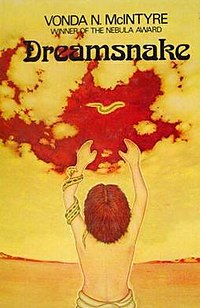
1979: Dreamsnake


Dreamsnake(1stEd).jpg


               The 1970s were a great decade for science fiction. There many great books ranging from hard SF stories about ringed planets and self-contained ecosystems in space craft to soft SF stories of cloning and individuality and genderless societies to stranger tales of resurrected people living on the banks of an endless river and three gendered aliens. It was the first decade a woman, Ursula Le Guinn, won the Hugo Award. In fact, four out of the ten 1970s winner were written by women including 1979’s Dreamsnake by Vonda N. McIntyre. In a decade of great highs, Dreamsnake holds its own but does not reach the heights of such classics as The Left Hand of Darkness, The Forever War, and Gateway.
                Dreamsnake takes place far in the future after a nuclear war has rendered vast swaths of the landscape radioactive. Yet it is not a desolate world with small groups struggling to survive. Society has reformed and the old world is mentioned only in passing. I love how McIntyre implies years of history to the world without giving too much detail. Like the Hechee in Gateway, the reader is only able to guess and infer what has happened. For example, title creature is from another planet but the reader is never told what planet, why they came to Earth or how brought them there. Further on that point, the main character goes to a city that still trades with aliens but she is unable to get in and we the readers never learn anything about the aliens and very little about the closed city that trades with them. It’s a nice mystery that enhances rather than detracts from the story.
                The story itself is about a healer named Snake who uses three snakes; a rattlesnake, a cobra, and the eponymous dreamsnake, and her trails to replace the dreamsnake after a misunderstanding with some tribespeople led to its death. Snake’s journey is not straight path since she does not know quite how to replace the rare dreamsnake and is loath to return to the healers and admit her failure. She travels through the land, helping people as she can with her two remaining snakes, picks up a companion, and ultimately succeeds in her goal. While that may seem like a spoiler but how Snake accomplishes it a bit surprising but felt completely organic and not contrived.
                It might sound strange how snakes are used for healing but McIntyre explanation is original. The snakes are specially bred to metabolize medicines within their systems. Snake feeds the rattlesnake or the cobra a compound that turns their venom into whatever medicine she needs and the repurposed venom attacks the illness with the same ferocity that it would have as a poison. She uses the snakes to transmit vaccines to nomads and kill a nasty infection in a wounded leg. The dreamsnake’s purpose is different, however. The dreamsnake takes away the pain and calms people. It can be used to calm a person who is undergoing surgery or suffering from an illness or ease the passing of a dying individual. Without, Snake feels she cannot do her job sufficiently. It is an interesting and well realized idea that helps to show this future world as both similar to our current world but alien as well. While much of the world is less advanced that our world, for example people use horses instead of motor vehicles and some live nomadic lives, in some ways it is more advanced. The snakes are shown to be more effective that modern medicine and people are able to control their own biological functions to such a degree that unwanted pregnancy is virtually unknown. It is a great world and I do wish that McIntyre had created more stories within it.
                There is really not much else to say. Dreamsnake is a thoroughly enjoyable science fiction tale that entertained me but did not leave the lasting impression that some of the greatest works did. I am find with this. When I started this strange project a few years back, I did not expect every work to be great but I did hope that every work would be good. What is important is that Dreamsnake was good and I am glad this little project brought it to my attention.
                My next blog will be summary of my impressions of the 1970s as I did with the 1950s and the 1960s. After that it is one of the three “Greats” of science fiction: Arthur C. Clarke and his 1980 novel, The Foundations of Paradise. Happy reading until then!

Thursday, January 15, 2015

1978: Gateway

GatewayNovel.JPG

                After the absence of only a year, the Hugos go back into space with 1978’s Gateway.  The novel, by Frederick Pohl, takes place in a future where mankind discovers an abandoned base of a highly technologically advanced alien within an asteroid. The base comes with thousands of alien ships; many of which are still in working order. There is a catch: humans have no idea how to set the coordinates of ships so people volunteer to take the ships to their pre-set destinations. Some destinations contain riches, some contain nothing, and some ships never return. Every run is a gamble. It is a great premise that thankfully turned into a great book.
Concept can get a writer far in science fiction but it is not enough by itself. I was very excited for A Case of Conscience by James Blish (1959 Hugo Winner) because I found the concept of humanity meeting an alien species with no concept of God or Good and Evil would provide an interesting and philosophical tale. It was a great idea that fell apart in its execution. The aliens were boring and the novel extremely uneven. Gateway delivers on its premise far better. The novel has a bifurcated narrative. Odd numbered chapters are therapy sessions between the protagonist, Robinette Broadhead, and his robotic therapist, Sigfrid von Shrink (a name I both love and find ridiculous) and even number chapters detail Robinette’s (who usually goes by Rob) time on the alien base and his expeditions on the ships. The odd number chapters take place chronologically after the even number chapters and it comes clear quickly that Rob had been very successful in one his trips and is now independently wealthy. Why then would a man who has everything he could need or want to see a shrink? It is not hard to tell that Rob is hiding something from Sigfrid and possibly himself.
The structure gives the reader just enough of a hint to leave them constantly wanting more. Pohl takes his time building his characters, Rob especially. Rob is a great character because he is relatable, likable, but also petty, cowardly, and at times irritating. Besides one act late in the book which did not seem to fit his character at all, all of his actions seem organic and understandable within his character. He actions do not change just to make the plot work. I appreciated that Pohl did not give any major revelations about the aliens, called the Hechee, in Gateway. Their technology and society remains a mystery both to the humans in the book and to the reader. I read online that there are more books in the series that explain much more of this enigmatic race but I loved the mystery. I enjoyed speculating about their motives and their culture. It was well done. That being said, Pohl does not skimp on details and spends considerable time explaining how the base works, how humans have repurposed the ships, and how the payout system works for people who make discoveries. It’s a minor detail but Pohl even talks about how bathrooms are installed in the ships. Science fiction rarely deals with those kinds of mundane issues. Pohl’s universe has a very lived in feel which I enjoy. So much science fiction of the 1950s and 1960s (the Golden Age) feels a little sterile. Humanity is a bit grubby and I do not think we will stop being so in the future so I love sci-fi that acknowledges it. To use some more modern examples, I prefer the lived in worlds of the Alien movies and the original Star Wars trilogy to the shinning sterility of Star Wars prequel trilogy and Star Trek.
As much as I enjoyed it, there are some things in the book I just not like or found to be a bit of stretch. First of all is Rob’s occupation before he went into space. Rob was a food shale miner on Earth. In this future, Earth is overpopulated and impoverished and it is necessary to mine oil and shale to turn into food. While the overcrowded and starving Earth is not a new idea in science fiction (Heinlein wrote scores of books about space farmers), I found the idea of mining oil for food a bit ridiculous. It is a small bone to pick but I pick it none the less. Similarly, the gap between rich and poor in this world seems enormous to an almost comical degree. This aspect struck me when I first read the novel but now it seems more and more logical. There is also a minor event late in the novel that does not mesh well with Rob’s established character and I found off putting. It would make little sense to explain it out of context. If anyone else reads, please leave a comment with your thoughts. It would be hard to miss.
Gateway is a great combination of old and new science fiction. The old emphasis on exploration and discovery paired with more human stories with flawed and relatable characters. It makes me want to read more Pohl. I would recommend this winner to just about anyone and I would say it was one of my favorites of the decade along with The Left Hand of Darkness and The Forever War.

The next book, Dreamsnake, is by the third woman to win the Hugo Award for best novel, Vonda N. McIntyre. Will the 1970s end as well as it began? Find out soon.  

Monday, January 12, 2015

1977: Where Late the Sweet Birds Sang

Wherelate.jpg

                Where Late the Sweet Birds Sang by Kate Wilhelm is about as significant of a tonal shift as I have yet experienced from the Hugo Award winning novel to another.  The Forever War was a Vietnam War allegory as told through a space opera, Where Late the Sweet Birds Sang is social commentary on individualism and environmental damage told through a struggle within a community of clones. The novels feel so different though each is effective in its own way. It just goes to show what variety exists within science fiction. But is Where Late the Sweet Birds Sang any good? Yes, but not quite as much as many that came before it.
                It is not immediate apparent but the title is an excellent reflection of the book. Where Late the Sweet Birds Sang is from the fourth line of Shakespeare’s Sonnet 73. Here is the sonnet in its entirety:
That time of year thou mayst in me behold,
When yellow leaves, or none, or few, do hang
Upon those boughs which shake against the cold,
Bare ruined choirs, where late the sweet birds sang.
In me thou seest the twilight of such day,
As after sunset fadeth in the west,
Which by and by black night doth take away,
Death's second self, that seals up all in rest.
In me thou seest the glowing of such fire,
That on the ashes of his youth doth lie,
As the death-bed whereon it must expire,
Consumed with that which it was nourished by.
This thou perceiv'st, which makes thy love more strong,
To love that well, which thou must leave ere long.
Like the sonnet, the book tells of the end of things: the pasSang of the day, the dying of a fire, the end of autumn. Where Late the Sweet Birds Sang begins as the world is ending. Pollution is cauSang endemic disease and starvation around the world and one family, the Summers, decide to retreat to their family lands and hunker down to survive the coming fall of civilization. He and the other members of his family realize that the pollution and disease has made many of them infertile so they use their resources to construct a cloning lab after one of them, David, realizes that fertility will eventually return after a few rounds of cloning. The only problem is the clones, which are created in groups of 4 to 10, decided that cloning is better and continue cloning groups of clones rather than reproduce individually. A new society eventually forms made up of groups of clones. The clones also develop a form of telepathy and cannot be apart for long.
                The novel is divided into roughly three parts: the original family that created the clones and the eventual takeover, an expedition of clones to the ruins of Washington, D.C. to find advance technology, and the life of Mark, a boy that was convinced and born naturally. These sections are not equal in length as Mark’s story is by far the longest and most interesting. Mark is an outcast and has a difficult time living in the clone society though they come to depend on him more and more throughout the novel since he does not need the community of his fellow clones.
                The main themes in Where the Sweet Birds Sang are individuality, love of nature (and an implied distain for high technology), and adaptation. There is an interesting back and forth between adaptation and individuality. The Summers family creates clones to adapt to the changes as society collapses but eventually the clones find that lacking individual hurts their chances at survival. Many works of science fiction show that one adaptation is necessary so it was interesting to read one where the adaptation failed to adapt. I do find the anti-technology bent in the story a bit disconcerting, however. Technology and its by product pollution caused the fall and the clones reliance on technology (cloning machines) cause its downfall. In the end, shunning technology is the salvation of mankind, so to speak. Living simply and closer to nature is shown in a rather idyllic way. The author, and many other works that take this view, seem to discount that in a pre-technologically advanced times, life tended to be nasty, brutal, and short (to borrow a phrase from Thomas Hobbes). Disease ravaged communities, hunger was a close companion, and the average life expediency was 40 years. There are drawbacks to living closer to nature that these works often do not acknowledge. It is a minor point in the novel and only really comes up near the end but it is still irritates me.
                There were a handful of aspects I found strange about this novel. The end of the world is described rather vaguely. There is disease and famine but not much of description of how society breaks down. The characters in the first section retreat to their family lands in a remote part of Virginia and that’s that. Apparently, they don’t have to deal with marauding gangs of survivors like every other post-apocalyptical tale I know of it. I’m not sure how I feel about that. On the one hand, it is nice not to deal with usual and tired trope but on the other I find it hard to believe that no one ever came by. The other is sexual promiscuity. It seems to be a fairly common element in a lot of science fiction that people are much more sexually promiscuous in the future. Part of me things this is projecting by the authors but that is just blind speculation. I am hardly a prude but the orgy that Mark comes across in the novel with a group of male clones and a group of female clones was a tad strange. It could be argued that since the groups of clones are almost one individual rather than separate brothers or sisters this is not as strange as it seems but to me it was disquieting to read about a group of brothers with a group of sisters.
                In its own strange way, that brings me to an interesting park I liked about the relations between the clones. The groups of brothers and sisters interacted somewhere between individuals and a collective mind. It was kind of like the relationship between a person and their daemon in His Dark Materials by Phillip Pullman. Each is somewhat an individual but they cannot live without their other part. It made the clones more interesting because they were not always of like mind with their fellow clones but enough that it was very difficult to deviate from the pack.
                I enjoyed Where the Late the Sweet Birds Sang. It was by far one of the better stories with clones (superhero comics are replete with terrible clone stories) but it did not grab me as some of the other winners from the 1970s. It just did not have the same level of depth. I would still recommend it but it is not a must read like The Forever War, The Left Hand of Darkness or Dune.
                Speaking of Dune, this is the first year where there was another book nominated for Best Novel that I have actually read. Children of Dune is the third of six Dune books written by Frank Herbert (the later ones written by Kevin Anderson are an abomination and should not be consider canonical). It has been many years since I read Children of Dune yet I remember liking but not nearly as much as Dune or its direct sequel, Dune Messiah. Only the first two are must reads. Children of Dune and The God Emperor of Dune have their moments and I disliked The Heretics of Dune so much that I have not even bothered to read Charterhouse: Dune. 
                Next we go back into space as I will review Gateway by Frederik Pohl. Happy reading until then!

Wednesday, January 7, 2015

1976: The Forever War

                 After a long hiatus, I am back and ready to catch up on all the reading I have done. At this moment, the beginning of 2015, I am actually 8 books ahead of the blogs I have written. This month, I would like bring you, my dear reader, up to the year I am currently on: 1983.


                The Forever War by Joe Haldeman is a great book to start 2015 with. Before I get into the book itself, I want to say how much I love this title. I am an absolutely sucker for a great title. There are books I have wanted to read simply because of the title. Once I almost picked up an audiobook called A Breath of Snow and Ashes because the title was so evocative. I was hoping for a grim story in some wintry place; stark landscapes and horrific events. Instead it is a time traveling romance set during the American Revolutionary War. Romances do not appeal to me much so I did not pick it up (it also was extremely long at 57 hours). Though I didn’t read it, the title has stayed with me for years. Particularly, titles that are The Something of Something appeal to me. The film The City of Lost Children is a personal favorite of mine and probably my favorite movie title of all time. The titles of the two books I am working on are A Season of Bad Roads (about post-Civil War Russia) and A Pocket Full of Shells (a steampunkish crime story) have those kind of titles. The Forever War evokes images of a grand struggle; complex and epic filled with high stakes action and complicated characters. As I read it, however, I found that it was not most of things but was a great read in a different way.
                The Forever War, despite its centuries spanning conflict and futuristic scenarios and weapons, is commentary and reflection on the Vietnam War. It is the story of a young soldier, William Mandella, who has been drafted to serve in the United Nations Exploratory Force being assembled for a war against the Taurans. The Taurans attacked a human colonial expedition and seem to be trying to take other planets that humans are trying to colonize. I say seems because, until the end of the book, there is no way to communicate with the Taurans. Mandella serves his two years but due to relativity more than four decades have passed since he left. Earth is a much different place. Overpopulation has led to food shortages and even the currency has changed to calories. His father is dead and his mother does not know how to relate to him. Eventually, Mandella leaves his mother’s home and goes to live with his lover’s family on a farm. The world they left is so different Mandella and his lover reenlist. Neither wants military life but there does not seem to be anything left for them. From there, Mandella goes on to serve a number of tours, each time advancing in rank (while hundreds of years pass) but becoming farther and farther removed from human society. For example, he eventually leads a team that does not speak the same language as he does (they learn 20th century English for his sake) and they are all homosexual which has become the norm by that time.
                The novel shows how the experience of war removes a person from “normal life” and the difficulty of going back to a world that has moved on without the soldier. As an Iraq War veteran myself, this part of novel strongly spoke to me. The world is never quite the same when you come back. People you know are there but they are not the same and neither are you. Relationships that were simple become strained. The old world seems strange. Granted, when I returned from Iraq in 2004, the world had not as drastically changed as did for Mandella but it was still difficult. Even now, a part of me misses my time in Iraq because the world seemed simpler and I believe that is why Haldeman, who was a Vietnam veteran himself, kept having Mandella return to the “comfort” of military life.  I think that this phenomenon is unique to post-World War II wars. World War II consumed the life of the nation. When the war ended for the soldiers it also ended for the country. The Vietnam and Iraq Wars were not like this. People may say that “we are at war” but “we” as in the general population are not. For a majority of the population, the war exists outside their lives. That’s how the world can go on while the soldiers are away. The general populous suffers none of the hardships that the military face. Haldeman captures this strange sensation and the cost it brings to those that fight.
                Haldeman’s experience in Vietnam also gives a weight and danger to battle scenes. While I enjoyed the battles in Starship Troopers, there is a tautness and dread in The Forever War that was missing in Starship Troopers. Perhaps it was because people always died for a reason or as part of the battle in Starship Troopers. In The Forever War, bad things happen and soldiers are killed from accidents and stupidity as well as actual combat. War is nasty business and Haldeman portrays it as such.
                There are a few grips I have about this book; despite how much I liked it. I found it hard to believe that there were not more attempts to actual talk to the aliens. This could be because the story is completely from Mandella’s perspective so we only know what he knows but it still seems hard to believe. Mandella’s team of recruits are all people with an IQ of above 150 which Haldeman pushes as important but it never really feels that way. Perhaps it helps them learn the complex weaponry but it does not seem necessary to have physics and chemistry students as front line troops. Finally, as a political scientist, I have a hard time believing that human society and government would hold if it was falling apart as much as it was when Mandella first returns to Earth. Wars cause societies to break from the inside and if the Earth society was collapsing, I don’t see how the military leaders could keep the war going. These are minor quibbles however of an excellent book.

                Go read The Forever War. It was one of the highlights from the 1970s Hugo award winners and that is saying something. I only wish I had read it sooner. Next up is Where Late the Sweet Birds Sing by Kate Wilhelm, the second woman at this point to win a Hugo. It has a great title but is it a great book? We shall see. 

Thursday, August 7, 2014

1975: The Dispossessed

For my few readers, I apoligize for the long delay. I spend the last year in Italy as part of my graduate studies and the summer traveling across Russia, Mongolia, and China. I plan to catch up in the next few weeks. Thank you. 

Reading The Dispossessed, 1975 Hugo Award winner, by Ursula Le Guinn a couple years ago is what gave me the idea of reading and blogging about all the Hugo Award winners. I have always found it difficult to pick a new book to read. My interests vary greatly. I have loved science fiction and fantasy since I was a boy but I also have a strong passion for classic literature (I decided to learn Russian in college because I loved the works of Dostoevsky) and modern fiction. My day job, and more often than not, my night job, is in international relations and politics so I read a great deal within that field as well. That was a rather long way of saying that my reading time is precious and it is hard to pick a book.
                Science fiction and fantasy are particularly difficult because there is so much out there and so much that is not very good. My wife will stop reading a book if she doesn’t like it but I find that too difficult. Once I start, I am committed. It’s usually a good thing though I have been burned in the past. Lisey’s Story by Stephen King is terrible and I really should not have read the whole thing. Seriously, much of King’s work is excellent but Lisey’s Story would not have been published if it wasn’t by Stephan King. Since I have such a hard time picking a book to reading all the Hugos seemed like a good idea. In the 4 years since I started, I have read over 20 Hugo winners and they have been more hits than misses. I have learned more of the rich history of science fiction (there has not been many fantasy works so far) and have enjoyed the experience immensely.
                So what of the book that inspired this quest? If the fact that The Dispossessed inspired me to read over 50 books did not give it away, I rather liked it. Ursula Le Guinn is one of the best writers to win the award. She has a true talent with words and worlds. Like her previous winner, The Left Hand of Darkness, The Dispossessed creates a detailed and fascinating world, or more accurately two worlds, that feel full realized with their own history and philosophical underpinnings.
The Dispossessed takes place on twin worlds, Urras and Anarres. Urras is a lush and abundant world while Anarres is harsh and barren. Over a hundred and fifty years before the beginning of the novel, a group of anarchists left Urras and settled on Anarres. There they curved out a unique society based on anarchist principles which turned out to be not the utopia its founders may have originally envisioned but a functioning society nonetheless. I enjoyed that chapters set on Anarres more than the chapters set on Urras mostly because I enjoyed trying to understand how their society works. While I found it mostly believable, I still found it difficult to believe that there were not more abuses of the system. Le Guinn implies that the largest problem the anarchist society faces is intellectual stagnation.  Orthodoxy and strict adherence of the political wisdom of the movement’s founder has replaced innovated thinking. While this is certainly a problem, most of the people still follow its rules and do their part. The main character for example, Shevek, still works in the fields when he is required to and still works in the sanitation when it is his turn despite that fact that he is a brilliant physicist and it would seem a waste of his time to do anything else. Utopian systems break down because of the inherent jealous, selfishness, and contradictions in human nature. Anarres makes more sense for not changing since it heavily restricts interaction with Urras and its founding members all had the same beliefs unlike communist countries that had an elite that may have, at one time, believed in communist principles but a larger society may be, if not outright hostile to communist, at least generally indifferent to it.
The other aspect I had difficult is with the language used on Anarres. It is a created language like Esperanto or Klingon. It is very logical and also makes it impossible to express certain ideas in keeping with the ideas of the anarchist society.  The theory that language determines thought in this manner is called Sapir–Whorf hypothesis. This is a common idea in science fiction perhaps most famously from George Orwell’s 1984 in which the new language Newspeak makes it impossible to say the party is bad. In The Dispossessed, the only word to use to describe having sex is “to copulate” since that word has no connotations of dominance that would be out of step of the egalitarian ethos of the anarchist society. The problem with this idea is that is disregards the ingenuity of humans. A wonderful counter to Sapir-Whorf is found in Gene Wolf’s Citadel of the Autrach in which a person from a society where they are only allowed to speak in approved sayings tells a story that is critical of the ruling class. It is a brilliant chapter and demonstrates how people can find ways to say what they mean to say.
These quibbles are minor, however. The Dispossessed still tells a great story about a man named Shevek, the above mentioned brilliant scientist, travels from Anarres to Urras so he can interact with the great minds on the far more developed planet. The chapters are divided between the two planets with even numbers about Shevek’s time on Urras and odd number ones about his previous time on Anarres. Neither society is portrayed as perfect or idyllic. Le Guinn does an excellent job creating real characters living in a society considerably different than the readers would know. No character feels like a mouthpiece for the author’s views and nothing is heavy handed. Le Guinn mostly successfully creates a living breathing world were society is quite different from what we know with it feeling forced. I could only hope to create such a convincing world in my own writings.
The Dispossessed is a worthy addition to Le Guinn’s Hannish cycle. In fact, the novel is set many years before The Left Hand of Darkness. The ansible that Genly Ai uses in that novel is the creation of Shevek. I am glad I read the book and have enjoyed every other work of Le Guinn’s that I read since.

Next book is The Forever War, the classic anti-war novel by Vietnam veteran Joe Haldeman. As a veteran myself (Iraq, not Vietnam), I was looking forward to this. Until next time!

Tuesday, September 10, 2013

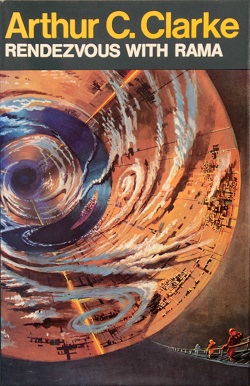
1974: Rendezvous with Rama

               After 19 Hugo Award winning novels, I am finally reviewing the last of the “Big Three” of science fiction: Arthur C. Clarke. Clarke is most famous for 2001: A Space Odyssey which strangely did not win the Hugo when it was published in 1968. It wasn’t even nominated.  Even though he casts a large shadow over science fiction, I had not read a single work (not even a short story) by Clarke until I came to 1974’s Rendezvous with Rama. I am sorry it took this long because Rendezvous with Rama is fantastic and, so far, tied with Hand of Darkness as my favorite Hugo Winner of the 70s.
                Rendezvous with Rama is a strange book to find so engrossing because there is no real conflict. There is a small conflict with colonists from Mercury but it doesn’t drive the plot for the most part and doesn’t feel that important. Instead of conflict, Rendezvous with Rama gives the reader the thrill of discovery. This is a book about the joys of exploration on a new and foreign land.
                This new and foreign land is not another planet but a large asteroid-like space craft that appears in our solar system in 2130. Named Rama by human authorities, the space craft is perfect cylinder measuring 34 miles long and 12 miles in diameter. A space ship is sent to intercept the craft before it rounds the sun and travels outside of the system. The team, led by Captain Bill Norton, lands on Rama and begins to explore.
             
              There really isn’t too much else I can say about the novel. To tell too much would ruin the sense of discovery Rendezvous with Rama imparts. Clarke slowly reveals more and more about the spaceship and leaves just as many questions as answers by the time the crew is forced to depart. The little pieces of the book’s universe are revealed through the crew members but exploration is the heart and soul of the novel.
                Clarke was a physicist so it is no surprise that Rendezvous with Rama is hard SF. Hard SF is a type of science fiction that strives for scientific rigor. It is like comparing 2001 to Star Wars. The crew is scientists (the stereotypical characters of hard SF) and they try to understand and explain how Rama works. Rather than take away from the sense of wonder that runs through the book, the scientific detail enhances it.  These details create a feeling of awe at the immensity of the craft and its complex workings.
                Sadly, Rendezvous with Rama ends just as a number of fascinating discoveries are being made. The book ends with a teaser that other Rama-like craft are on their way but it is just that, a teaser. There are sequels but they are written by a man named Gentry Lee and they are supposed to be terrible. From what a friend told me and what I read on Wikipedia, the sequels lose the sense of wonder and awe and replace it with bad plotting and excessive sex.
                If you enjoy a tale of wonder and discovery, Rendezvous with Rama will not leave you disappointed. I loved it and it makes me excited to read other works by Arthur C. Clarke. He has an impressive bibliography so I am sure there are other gems to discover.

                Next time I will take a look at another Ursula LeGuin work, The Dispossessed. Her last Hugo Winner was great so I have high hopes for this one. 

Saturday, August 31, 2013

1973: The Gods Themselves

Isaac Asimov is one of the big three of science fiction along with Robert A. Heinlein and Arthur C. Clark. The handful of lucky individuals that have been reading this blog will be no stranger to Heinlein. I have already read all four of his Hugo Award winning books. Clark will be next month and even though The Gods Themselves is my 20th Hugo winner, it is the first Asimov book to win and the first one I have ever read. Sadly, while I liked the book, I expected more from one of the greats of science fiction.
Whatever complaints I have with this book, the title was not one of them. I am a sucker for titles and this one immediately grabbed my interest. Who are these gods? I didn’t know and the back of the book didn’t give me much of any idea. Opening the book brought another surprise. The three sections of the novel formed a phrase of which The Gods Themselves was the middle part. The parts are called Against Stupidity…, …The Gods Themselves…, and …Contend in Vain? The whole quote is translation from Friedrich Schiller, an 18th Century German poet and playwright.
I know I am going on about the title but it did bring up my hopes to greater heights than was truly warranted. Now, don’t get me wrong, The Gods Themselves is a good book. Asimov’s writing style is utilitarian but it is still interesting. The problem is, with the exception of the second section, there is not enough drama which is strange since the stakes are so high. In the first section, we are introduced to a future where mankind has discovered a way to create cheap and seemingly limitless energy with a device called the Electron Pump. It doesn’t actually pump electrons but instead changes matter with matter from another dimension where the laws of physics aren’t quite the same.  Lamont, a young scientist, starts to research the Electron Pump and realizes that its creator, Dr. Hallam, may not have so much invented it as stumbled upon it. Lamont discovers two other startlingly facts: there are beings on the other side of the pump that started the process and that it is slowly changing the rules of physics in our solar system and will eventually cause the sun to nova. He tries to spread the word but it shut down by the scientific and political community because the Electron Pump is the basis for human civilization and no one can think of giving it up. I don’t know if it was Asimov’s plan but there is a strong parallel to contemporary oil and energy issues.
It is a good set up but Asimov gives the story such a weak ending in the third section that it doesn’t seem worth it. There is some dramatic tension but the solution is so easy and so painless that there is no impact. I was left wanting more.
So two of the three sections were a letdown but what about that second section: The Gods Themselves? I haven’t read much Asimov but from what I have read about him he almost never wrote about aliens. Robots were more his thing. It is a shame that he didn’t write more about aliens because if the second section is any indication, he was good at it. …The Gods Themselves… is about the aliens that created the Electron Pump. Their sun is dying and they need the energy. Not in the same way humans do though. The aliens absorb energy directly.  In one of the most interesting twists, they are divided into three sexes, Rationals, Emotionals, and Parentals. Asimov uses masculine pronouns for the Rationals and Parentals and feminine for the Emotionals but thinking of them as male and female is a mistake. They reproduce by melding with each other into a larger whole. The section doesn’t give a complete overview of their society but enough to understand each of the three sexes and the general structure. It is a wonderful story with a real sense of wonder and much more tension then the other two. Read it yourself; I won’t give the ending here. Asimov should have focused more on this and less on the real world story.

My first experience with one of the greats was a mild disappointment but I am not sorry I read it (unlike some other Hugo Winners). Asimov could have done so much more with this book. Hopefully the next winner from one of the greats, Arthur C. Clark’s Rendezvous with Rama, will be better. See you there next time.